
ODM Jewelry Development: Concept to Retail-Ready
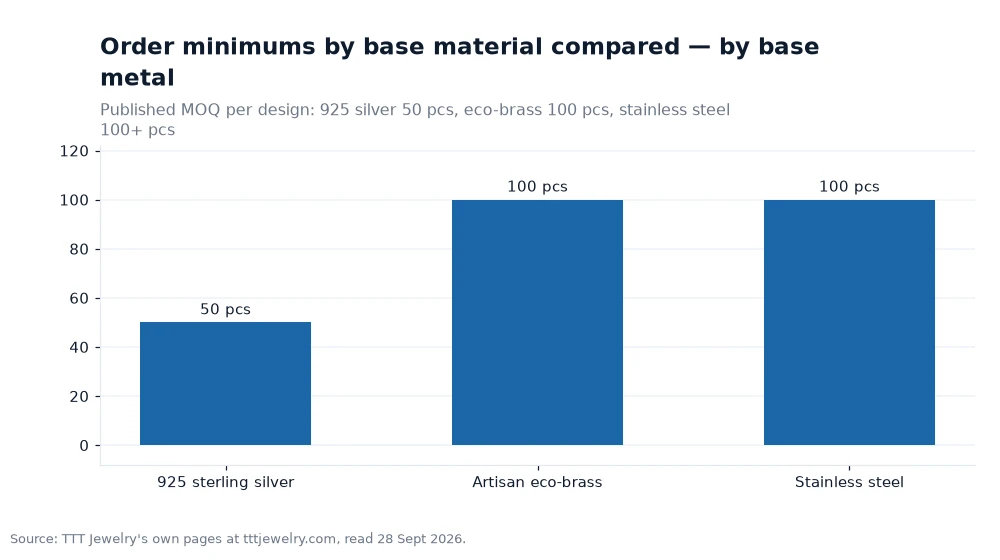
An ODM project starts at a mood board and ends at a carton that can go straight onto a shop floor. In between sit six customisation fields, a 3D CAD model delivered in under 48 hours, a 25–30 day master sample and a 3–4 week production block. Published minimums are 50 in sterling silver, 100+ pieces in the stainless line and 100 pcs in artisan brass, counted per design, and they hold design by design.
Key takeaways
- ODM covers concept, CAD in under 48 hours, sampling in 25–30 days and production in 3–4 weeks.
- Retail-ready means packaging too: logo tags, foil-stamped boxes, pouches, backing cards and barcode labels.
- Minimums are 50 / 100 / 100+ pieces per design depending on the base metal.
- Moulds, CAD files and the collection stay exclusive to the buyer's brand under a 100% NDA.
What retail-ready means beyond the jewellery
A piece is not ready for a shelf when it is polished. It is ready when it has a barcode, a backing card that holds it at the right angle, a pouch that survives a customer's handbag and a box that survives a courier.
The published packaging list covers five item types, and all five are specified with the piece rather than after it. That is the practical difference between a manufacturer shipping product and a partner shipping a product that can be listed.
The four gates of an ODM development
Gate one is inquiry, where sketches, reference photos or a written concept are enough. Gate two is the consultation that settles feasibility, material and cost structure. Gate three is the 3D CAD model with renderings, delivered inside 48 hours. Gate four is the master sample, 25–30 days of wax printing, casting, stone setting, polishing and electroplating.
Each gate is a chance to stop cheaply. Once the sample is approved, the remaining published window is the 3–4 week production block, and changes get materially more expensive after that.
Designing the minimum into the retail price
The minimum and the retail price band are the same decision seen from two ends. A silver design at 50 pieces per design can support a higher unit price and a smaller first order. A brass design at 100 pieces per design needs a lower price and more volume to clear the same shelf space.
Stainless steel at 100+ pieces per design is the volume route, which is why it usually appears in ranges sold as everyday pieces rather than seasonal items.
Why exclusivity changes the economics
A custom jewelry manufacturing services programme that develops a design for one buyer and then sells it to another has quietly shifted the risk back onto the brand. The published commitment on this point is a 100% NDA, with moulds and CAD files staying with the original buyer and the collection exclusive to their brand.
That changes the arithmetic on development spend. If the design is exclusive, paying for concept work once buys several seasons of differentiation. If it is not, the same spend buys a piece that will appear on three competitors' sites within a quarter.
| Item | Published figure | Where it is decided |
|---|---|---|
| 925 sterling silver minimum | 50 pcs per design | Specification stage |
| Artisan eco-brass minimum | 100 pcs per design | Specification stage |
| Stainless steel minimum | 100+ pcs per design | Specification stage |
| Packaging item types | logo tags, boxes, pouches, backing cards, barcode labels | CAD stage |
| Design exclusivity | 100% NDA | Before development starts |
The compliance pack that makes a listing possible
Retail listings increasingly ask for documents rather than samples. REACH restrictions on lead, cadmium and nickel, a BSCI social audit and ISO 9001:2015 certification, cadmium and nickel.
Ask for these at the start of an ODM project, because a retailer's compliance team will ask for them at the end, and a launch date can move on paperwork rather than on production.
What a retail-ready carton contains
The published packaging set covers five item types: foil-stamped boxes, velvet or microfiber pouches, logo tags, barcode labels and display backing cards. Together they turn a finished piece into stock that a warehouse can receive.
All five are specified at the CAD stage so the geometry works. A piece designed without knowing its backing card is a piece that will be rehung before it is shipped, which costs time inside the 3–4 week production block rather than before it.
Phasing a launch across two materials
A common pattern is to open with silver and follow with a plated line. Silver at 50 pieces per design lets a brand test a silhouette at the lowest published quantity, and if it sells, the same design can move into artisan eco-brass at 100 pieces per design with a lower metal cost behind a 14K, 18K, 24K gold or rhodium plate.
The schedule does not change between the two phases: 25–30 days for the master sample and 3–4 weeks for production, unless the tooling is reused, in which case only the production block and its inspection remain.
Measuring a launch by what the customer receives
The finished piece is only part of what a brand ships. A pouch, a box, a backing card, a logo tag and a barcode all arrive in the same carton, and each one is specified before sampling rather than after.
That is the argument for treating packaging as a design field instead of a fulfilment task. A box that is one millimetre tight will slow a packing line, and a backing card that is one size out will hold a pendant at the wrong angle for every photograph a stockist takes.
Under the published OEM/ODM route the packaging is part of the six customisation fields, so it is quoted with the piece rather than bolted on.
Worked example: spreading development cost over the first run
Compare two launches of the same design. In silver the published minimum is 50 pieces, so development is spread over 50 units. In brass the minimum is 100 pieces, so the same development is spread over 100 units and the per-unit share is halved: 50 ÷ 100 = 0.5, or 50%.
Add the schedule. A 25-day sample plus a 3-week production block is 3.6 + 3 = 6.6 weeks of factory time for either launch, and the 30-day, 4-week end of both windows is 4.3 + 4 = 8.3 weeks.
So the development spend per unit is driven by quantity, while factory time is not. If a brand wants the lowest cost per piece, it should raise the run length before it tries to shorten the schedule.
Frequently asked questions
What does ODM include that OEM does not?
Concept development: the factory produces the design, a 3D CAD model with renderings inside 48 hours and a physical master in 25–30 days, then keeps files and moulds exclusive to your brand.
Can packaging be branded?
Yes. The published set covers backing cards, velvet/microfiber pouches, gift boxes stamped in foil, metal logo tags and labelling with barcodes, all specified at the CAD stage.
How many pieces does a first launch need?
The minimums are 50 pieces in the silver line, 100 in artisan brass and 100+ pcs in stainless steel, counted per design quoted per design.
Building the launch backwards from the shelf
Start with the packaging and the price band, then work back to the metal, the minimum and the schedule. That order keeps the development spend pointed at a product that can actually be listed. The wholesale setup covers how ranges are quoted after the first run, and the plated brass range is the lowest-cost route to a printed packaging set.
Tracked back — laser engraving for logos; the approved-sample benchmark, the ISO 9001:2015, BSCI and REACH claims — every one of them came from the maker's own site at tttjewelry.com, as of 28 Sept 2026. The percentages quoted above are mine rather than the manufacturer's[1].