
Quality control in a scented range is not a final inspection; it is a series of checkpoints placed where a small deviation would otherwise become a large one. In home and personal care work the highest-value checkpoints sit at incoming materials, at the fragrance-to-base combination and at the pack interface, because those are the points where the product either holds its identity or stops being the product that was approved. For a festive gifting range the stakes are higher still: a drift discovered before gift assembly is a correction, and the same drift discovered after the boxes are packed is a lost season.
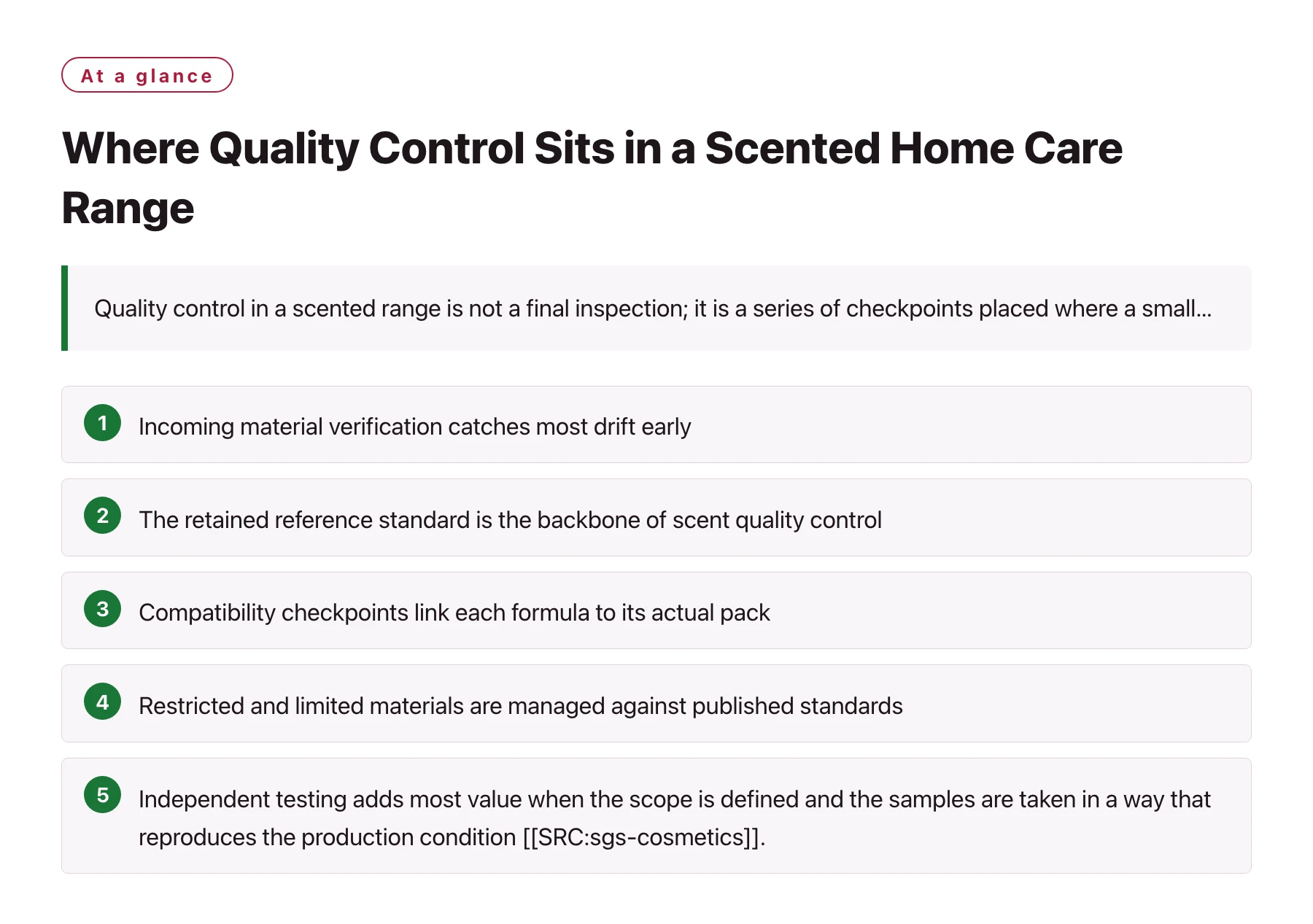
Key takeawaysIncoming material verification catches most drift early, because a scent is only as consistent as the materials and the base it is added to. · The retained reference standard is the backbone of scent quality control, and a reorder is only comparable if a sealed reference from the approved batch still exists. · Compatibility checkpoints link each formula to its actual pack, and the interface between liquid and closure is where many late defects originate. · Restricted and limited materials are managed against published standards, so the checkpoint is a documented review rather than a judgement call [1]. · Independent testing adds most value when the scope is defined and the samples are taken in a way that reproduces the production condition [2]. · Gift assembly introduces handling and storage steps that have to be checked as part of the product's quality plan, not treated as logistics.
Most quality problems in scented ranges are not failures of inspection; they are failures of placement. A check performed at the wrong point in the sequence confirms that something is wrong without leaving time to correct it. A check performed at the right point turns a deviation into a routine adjustment.
Home and personal care products are a good illustration because the scent interacts with everything around it. The base, the surfactant, the preservative system, the pack material and the storage temperature all influence how the fragrance reads. Quality control that only compares the finished liquid to a sample at the end misses the interactions that produced the difference.
What follows is a checkpoint map from a quality lead's perspective: what is checked, at which stage, and what should trigger a hold rather than a note.
The checkpoints in sequence
- Incoming material verificationConfirm identity, lot and supplier documentation for fragrance compounds and key base ingredients before they enter production, and keep a sealed sample of each lot.
- Fragrance-to-base combination checkVerify that the scent reads as approved in the actual base, not in a neutral carrier, and record the result against the specification version.
- Restricted-material reviewConfirm the formula still complies with the applicable industry standards for the product category being produced that day [1].
- Pack interface checkTest the filled pack under realistic conditions, including contact with the closure, pump or cap material, and inspect for any interaction that changes appearance or scent.
- In-process fill and weight controlCheck fill volume and closure torque at intervals through the run rather than only at the start, because drift appears mid-run more often than at the beginning.
- Bulk comparison against the retained referenceCompare a production sample against the sealed reference from the approved batch and record the outcome, including who made the judgement.
- Gift assembly checkInspect the assembled gift pack, including insert fit and any movement in transit, because the customer experiences the assembled unit rather than the individual component.
- Pre-shipment reviewConfirm documentation, labelling and retained samples match what the destination market requires before the pallet leaves.
What each checkpoint is measuring, and when to hold
| Checkpoint | What is measured | What should trigger a hold |
|---|---|---|
| Incoming material | Identity, lot traceability, supplier documentation, sealed sample | A lot that cannot be traced to the specification or a reference sample that does not match |
| Scent in base | Odour match against the approved specification | A readable difference that persists after the standard settling time |
| Materials review | Compliance with the applicable standards for the category | Any formula whose status has changed since it was last reviewed [1] |
| Pack interface | Appearance, closure function, scent after contact | Any change in colour, clarity or scent that develops after filling |
| Fill and closure | Volume and seal integrity across the run | Drift beyond the agreed tolerance, or a trend in one direction even inside tolerance |
| Bulk comparison | Agreement with the retained reference | A difference confirmed by two people rather than one |
| Gift assembly | Insert fit, movement, presentation | Components that shift in transit or a pack that opens during handling |
| Pre-shipment | Documentation, labels, retained samples | A missing market-specific document or label element |
The rule behind the third column is worth stating plainly: a hold is triggered by a pattern, not by a single reading. One unit outside tolerance is a sample; three in the same direction are a process. Distinguishing the two is what keeps a factory responsive rather than defensive, and it is the behaviour that protects a gifting range from a late surprise.
Why these checkpoints matter more in a seasonal range
A seasonal gifting range compresses production into the weeks when every other brand is producing too. That has two consequences for quality. First, lines run faster and changeovers are more frequent, which is exactly when drift is more likely. Second, there is no time for a discovery late in the process, so the value of an early checkpoint rises sharply.
The retained reference also becomes more important than usual. A festive range is often reordered the following year, sometimes with a different supplier. If the reference standard and the specification version were retained, the reorder can be compared against something concrete. If they were not, the second production effectively starts from memory, and memory is a poor specification.
Testing has to be scheduled, not requested late
Compatibility and stability work measures change over time, so it belongs to the middle of a project rather than the end. Laboratories publish the scope of the cosmetic, personal care and household testing they offer, which makes it possible to define a testing package against a real menu rather than a vague request [2]. Commissioning that work early turns testing into a checkpoint that informs the specification instead of a final gate that delays shipment.
It also helps to decide in advance which tests are performed internally and which are sent out. Both arrangements exist and both can work. What does not work is discovering the split after production has started, because the external work has its own queue and its own sample requirements.
The habits that hold up over a long production history
Quality control in this category is less about individual inspections than about the accumulated habits of an operation: sealed references kept by batch, specifications that carry version numbers, decisions attributed to a named person, and a documented process for handling a deviation. Manufacturers that have produced fragrance for a long time, such as Xuelei fragrance brand, which describes 31 years of manufacturing on its own material, tend to have those habits embedded in how they work rather than added as a response to a customer request.
For a buyer, the practical way to test those habits is to ask for three things that a well-run operation has anyway: the reference standard from a recent batch, the specification with its revision history, and the internal record of how a previous deviation was handled. Any operation that can produce those three is describing a process with checkpoints rather than an inspection regime, and that is the difference a seasonal range depends on. It is also the discipline that makes a review of fragrance manufacturing under one roof meaningful rather than theoretical, and the same questions apply when safety testing in a production run is being discussed safety testing in perfume manufacturing.
If a gifting range can only support two extra checks, add them at incoming materials and at gift assembly. Materials control protects the scent, which is what the customer bought. Assembly control protects the package, which is how the customer judges it. Between those two, most of the defects that would ruin a season are caught while there is still time to do something about them.
Sources
- IFRA Standards Library (International Fragrance Association) —— The IFRA Standards Library lists the restrictions the fragrance industry applies to individual fragrance ingredients, based on safety assessments; it is the reference point for compliant fragrance formulation.
- SGS: Cosmetics, Personal Care & Household Testing —— Testing, inspection and certification services for cosmetics and personal care, including microbiological, stability and safety testing aligned with cosmetics GMP.
Frequently asked questions
What is the most important quality checkpoint in a scented range?
Incoming material verification, because everything downstream inherits its consistency. A fragrance compound or base that differs from the approved specification cannot be corrected later in the process, and comparing finished product against a reference will only confirm the problem.
Why is a retained reference standard necessary?
It is the only reliable way to compare a later batch against the approved one. Without a sealed reference, a reorder is assessed from memory or from a written description, and small differences that a customer would notice cannot be identified objectively.
Should testing be done in-house or independently?
Both arrangements are common, and the choice matters less than the scope. What matters is that the tests are named, scheduled with enough elapsed time, and that the reports are retained by the brand as well as the manufacturer.
How should a brand check the quality system of a new supplier?
Ask for artefacts rather than assurances: a recent reference standard, a specification with its revision history, and the record of how a previous deviation was handled. Operations with a working system can produce those quickly; operations without one tend to describe the system instead.
Does a gift format need additional quality checks?
It needs an assembly check on top of the product checks. Insert fit, movement inside the box and the behaviour of the closed pack during handling are the items that most often disappoint customers, and they are visible only at the assembled level.