
One Code, Six Friends: Running a Small Mining Club
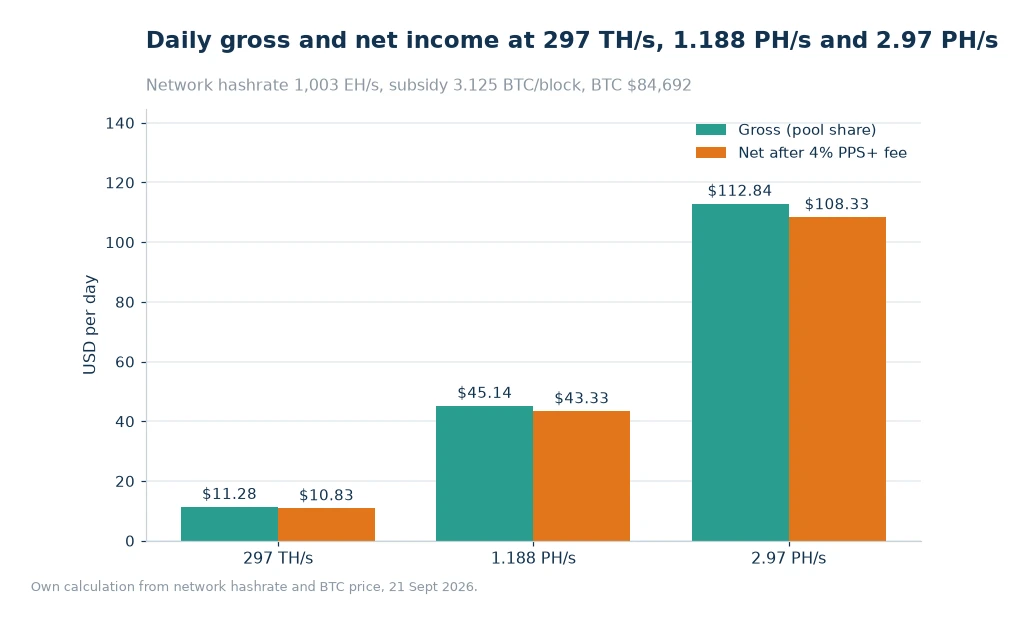
Five people sharing a lock-up can split a meter, a fan wall and a router, and still keep their own machines. Together they might run 297 TH/s, which nets about $10.83 a day at $84,692, or $4.38 for the member contributing 120 TH/s. The hard part of a club is never the hashrate; it is agreeing, in writing, what happens when one person wants out.

Key takeaways
- Splitting fixed costs is the real saving: one meter, one connection and one fan wall across several owners.
- At 297 TH/s combined, the club nets $10.83 a day, and each member's share should follow contributed hashrate, not seniority.
- Keep separate worker names for every machine so a payout dispute can be settled with data.
- Write the exit rule before the first machine is plugged in, because that is the conversation nobody wants later.
The club exists to share a meter, not a machine
Ownership is the part that must stay separate. Each member buys and owns their own hardware, keeps the serial number, and can remove it without asking permission. What the club shares is the building, the power feed, the network connection and the cooling. Those are the costs that make a single machine uneconomic in a city and tolerable when divided five ways.
The distinction protects friendships. A shared machine invites arguments about whose settings it runs, who damaged a board, and what it is worth when someone leaves. A shared building invites a much simpler argument about a monthly bill, which can be settled with a meter reading and a division. Keep the serial numbers on a shared sheet, photograph each machine on arrival, and the ownership question is settled before it is ever asked.
Who owns what when the payout address is the same
Most pools let one account host several workers, which is convenient for a club: one login, one set of statements, one place to check. The risk is that everything lands in one balance, and the club then has to trust its treasurer to divide it correctly every month.
A cleaner arrangement is one account per member, all pointing at their own addresses, with the club maintaining a shared record of which machine belongs to whom. The room stays shared; the money does not. That costs each member a few minutes of setup and removes the single largest source of disagreement before it can start.
297 TH/s split three ways
The table models a three-member version of the club, since that is the smallest group where the arithmetic is still interesting. Shares follow contributed hashrate, and the dollar column uses the club total of $10.83 a day.
| Member | Contributed hashrate | Share of club | Net USD per day |
|---|---|---|---|
| A | 120 TH/s | 40.4% | $4.38 |
| B | 100 TH/s | 33.7% | $3.65 |
| C | 77 TH/s | 25.9% | $2.80 |
The percentages are worth checking against the power bill. If the club splits electricity equally rather than by hashrate, member C pays the same as member A for less than two-thirds of the output. That arrangement can survive if the difference is small, and it will not survive once one member upgrades.
Why one introduction serves six people
When someone joins a club, they usually arrive through another member rather than through a search engine. That is the natural channel the ViaBTC Referral programme is built around: an existing miner explains the setup to someone who is about to buy their first machine, and the platform records the connection.
A club amplifies that because the explanation gets reused. One member learns how the payout schedule works, how to read the share counter, and what a reasonable daily figure looks like at a given hashrate, and then answers the same questions for the next person. The introduction is a side effect of a working room rather than a marketing activity, and it works best when the person explaining can point at a machine that has been running for a year.
The rules a chat group needs in writing
Four rules cover most disputes. Power is billed by submeter or by hashrate share, and the method is named in advance. Machines are individually owned and individually removed. The shared costs — rent, connection, fans — are divided by a stated formula. And any member may leave with thirty days' notice, taking their hardware and their payout address with them.
The fifth rule is the one people forget: what happens to a machine that fails and sits idle for a month. Does it keep paying rent? The kind answer is that it pays a reduced share for a stated period, after which it pays full. The unkind version, which is also the common one, is that nobody decided and the room quietly resents the empty slot. Spare fans, a spare PSU and a shared repair fund solve most of this before it becomes a rule at all.
Cooling and noise are club decisions
A shared room has a shared thermal budget. If one member adds a machine that pushes the room past what the fans can clear, every machine throttles. That makes cooling capacity a collective resource with a hard ceiling, so the club needs a rule about who may add load and who pays for the next fan. A workable version: whoever adds hashrate pays the measured cost of the extra airflow, and the ceiling is reviewed once a quarter against the hottest day in the room's log.
Noise is the same problem in a different form. A lock-up in an industrial estate has neighbours, and those neighbours complain to whoever answers the door. Keeping the door closed, the fans baffled and the hours predictable is cheaper than moving the whole club after a complaint. It also keeps the club on good terms with the landlord, who is the person most able to end the arrangement.
Worked example: one day in the shared room
The club's income is just the sum of its machines, which makes the arithmetic easy to audit.
- 450 BTC ÷ 1,003,000,000 TH/s = 0.00000044865 BTC per TH/s a day.
- 297 × 0.00000044865 = 0.00013325 BTC, or $11.29 at $84,692.
- Net after the 4% block-reward charge: 0.00013325 × 0.96 = 0.00012792 BTC, or $10.83.
- Member A's share: 120 ÷ 297 = 40.4%, so 0.404 × 10.83 = $4.38.
- Member B: 100 ÷ 297 = 33.7%, so $3.65.
- Member C: 77 ÷ 297 = 25.9%, so $2.80.
- Shared power at 5.94 kW and $0.07/kWh: 142.6 kWh × 0.07 = $9.98 a day, split by the agreed formula.
Frequently asked questions
Should a club use one pool account or several?
Several, one per member, all hashing in the same room; a single account concentrates the balance under one login, and at $10.83 a day for the whole club the accounting is not worth that risk.
How should shared power be divided?
By submeter if the room allows it, otherwise by hashrate share, written down before the first machine arrives so a later upgrade does not reopen the question.
What is a fair exit rule?
Thirty days' notice, hardware leaves with its owner, and the departing member's share of that month's bill is settled pro rata; anything vaguer turns a departure into a negotiation.
Agree the exit before the entry
A club is a small utility company with a shared meter and a shared door. Write the four rules, name the billing method, and keep the machines individually owned. Then the Mining Farms listing becomes a reference point for what a professional room costs, and the ViaBTC App lets every member watch their own worker without asking the treasurer for a screenshot.
Sources: ViaBTC referral, farms and app pages, with chain data read 21 Sept 2026 — network hashrate 1,003 EH/s, difficulty 132.76 T, 3.125 BTC per block, 144 blocks a day, BTC $84,692. Power draw and tariff are illustrative. Published 24 Oct 2026[1].